TYUNS !!
Tyuns is a collaborative worldbuilding project mainly hosted on a Discord server!

My job within this ecosystem is to maintain the Guzhono culture, religion and language. However, as the first map shows, im not alone in this.
The first of the two maps above highlights in purple the extent of the extant veenomic languages and peoples (as of T126, which was like up to 14/06/2026).
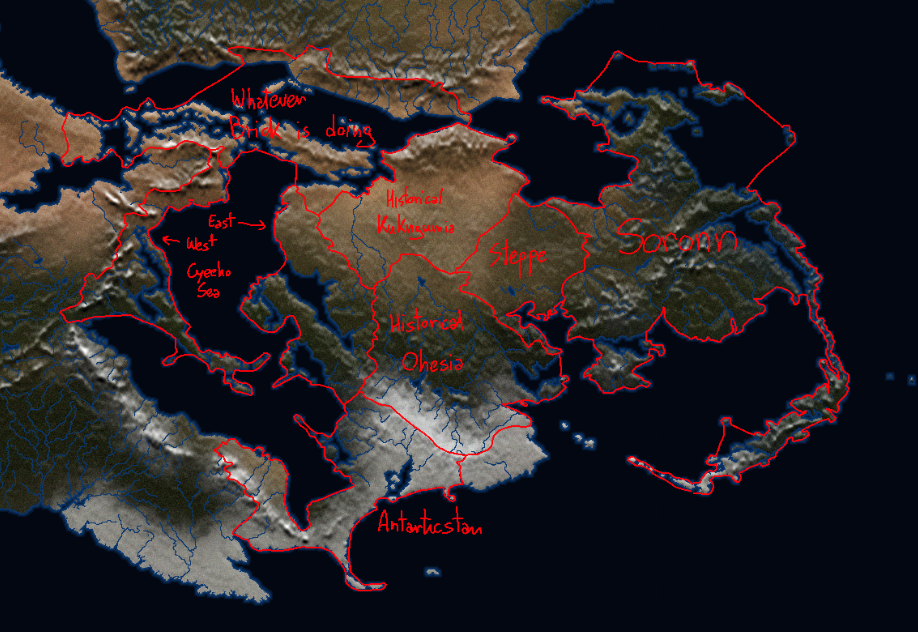
The second map shows the subregions of the Phosphoridian subcontinent. The main one being Soronn, the homeland of the Guzhono people and all other veenomic cultures.
Linguistics and Dictionaries
Around the year 57 of the 56th century of the Veenomic calendar, it was already known among Vanaghym scholars that the many languages of the people of their lands were governed by unknown laws. They even knew some of them were more similar than others, positing even a rudimentary theory of related languages. However, the main innovation that came out from this period was derived from the already extensive tradition of the Guzhon Council of creating bilingual versions of the Vanaghym Scriptures for missionaries to use in corverting foreign populations. Many of these missionaries came home after years abroad with lists and notes about the languages they had to be immersed in, mainly distantly related Vejpkisef and Ciouoo languages or even totally uninteligible Ohesian tongues. Eventually these notes were compiled by Guzhono scribes and were formalized into the first dictionaries, the fuCyrelčemojm "Groups of foreign words", which quickly became used as a tool in translating texts into and from the liturgical language Pwandukhun, the "Morally Correct Language". The first kind of dictionaries were the ones for languages already present in the Vanaghym canon, such as Liturgical Bivevgro, Classical Fienuom and Kalhk'itofxon, all related to the Morally Correct Tongue. As time crept on, more languages were blessed by this kind of attention: Omojgvahun, the modern vernacular spoken in the Council of Guzhon, and Kato, the ohesian tongue spoken by the government and religious elites of the western states of Sode and Izara.
K'ëvathi, god of War and Justice (Prompt T130)
Due to tradition and respect, the name of the gods are usually written in Pwandukhun, the liturgical language of the Vanaghym religion. K'ëvathi is the loyalist god of war, violence, death and combat when used as a tool to achieve Vann's justice. K'ëvathi is the enforcer of divine punishment and the protector of all of those who adhere to law and rules. To the “Obedient Weapon of Vann” there is no morality outside of the law codified by his father, therefore he is the protector of all of those who enforce rules: soldiers, governors, warriors and whoever might decide to take an action that, despite its moral ambiguity, respects Vann’s laws. K'ëvathi, despite the domain he holds and the fear and reverence he instills in his followers, according to some apochryphal books, he is also gay as fuck! Many stories, some from the Book of War, describe the god of violence in a perpetual quest to gain the favor of the Lord of Order through unquestioning obedience, swiftness of action and sometimes even by taking the initiative in certain matters to “Alleviate the First One’s Hands”. In some sources from the upper Jejombon basin (namely the cities of Kweč’okaruk and Küonokaruk) the dedication and obsession displayed by K’ëvathi for his lord is described with unique romantic undertones. In one of such apocryphal stories, titled the Laxa Vjošp'adrižor Ituštvnontwindu Cišammäwon Vejarkko čajK'ëvathi khös čajFwomöčč'ě (“Fourth Addendum of the Book of War about K’ëvathi and Fwomöčč’ě”, written by an anonymous), an episode is told where, before the death of Žaratt’a, both the God of War and the Blue Moth (Fwomöčč’ě, demon protector of trappers, hunters and ambushers) were in competition for Vann’s love, describing him with specifically carnally charged vocabulary such as Puvdu and Cuvžajdothu (“pretty, elegant” and “unseen” specifically used by Fwomöčč’ě to refer to Vann’s… assets). The story ends during the Cosmic War, with the battle between the two contenders, as K’ëvathi manages to hit the Blue Moth with a war hammer so violently that his soul and body separated.